CREST Hosts D4 Seminar on Engineering Sustainability Featuring India’s Govardhan EcoVillage as a Global Model for UN Sustainability Goals
NOVEMBER 21, 2025
The most recent CREST D4 Seminar spotlighted innovative pathways for building sustainable, resilient communities through engineering, with a compelling case study on Govardhan EcoVillage (GEV)—an award-winning model of integrated rural development in Maharashtra, India. The seminar brought together students, researchers, and faculty to explore how engineering practices can advance global sustainability while transforming local environments through community-based
approach.
The interactive session opened with an overview of Engineering Sustainability as a systems-based approach that integrates environmental stewardship, technological innovation, and community-centered design. The D4 Speaker Guru Mohanvilas Das, Sustainability Director, GEV, India, emphasized the growing need for engineers who can bridge disciplines—water, energy, agriculture, waste, and materials—to create solutions rooted in circularity and ecological balance. Participants examined how climate risks, population pressures, and resource constraints demand a new paradigm where engineering practice supports the transition to regenerative and nature-based solutions.
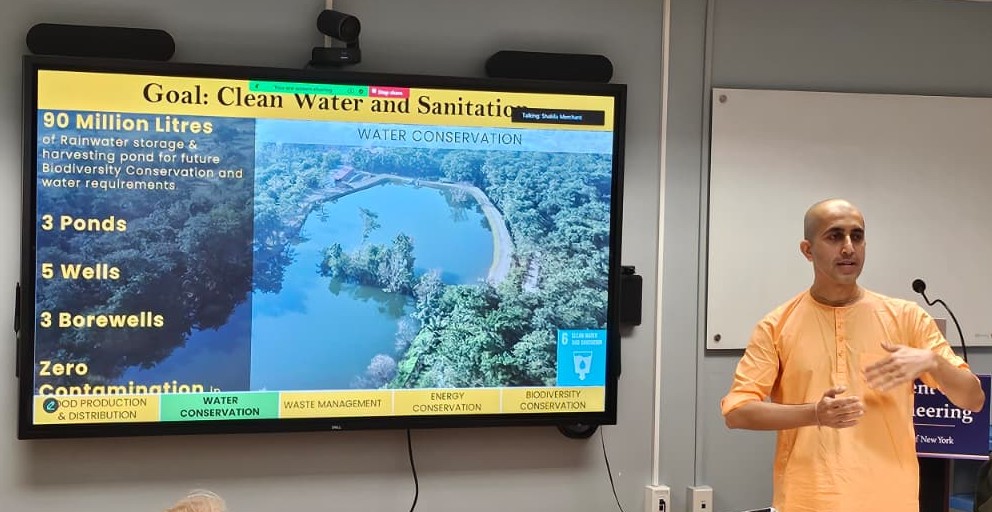
Govardhan EcoVillage is a living laboratory exemplifying this paradigm. Established as a rural sustainability initiative, GEV has implemented a suite of engineering-driven projects that include solar microgrids, biogas systems, rainwater harvesting networks, natural wastewater treatment, organic farming, and sustainable building using earth-based materials. Its holistic design supports both human wellbeing and ecosystem health, demonstrating how village-scale innovation can inspire scalable global frameworks, and aligns with multiple United Nations Sustainable Development Goals – SDG 6 (Clean Water and Sanitation) through decentralized wastewater treatment; SDG 7 (Affordable
and Clean Energy) by generating renewable energy; and SDG 12 (Responsible Consumption and Production) through its zero-waste and circular economy systems. In addition, GEV contributes to SDG 13 (Climate Action) with low-carbon technologies, SDG 15 (Life on Land) through ecological restoration, and SDG 4 (Quality Education) via experiential training programs that attract students and sustainability practitioners worldwide.
Participants engaged in a vibrant discussion about how lessons from Govardhan EcoVillage can be translated to urban and peri-urban settings, including New York City communities facing climate impacts, environmental justice challenges, and infrastructure vulnerabilities. The audience participated in water and carbon footprint discussions, which motivated them to assess their own ecological footprints.
The seminar reinforced CREST’s commitment to advancing research, education, and workforce development that prepares the next generation of Earth system scientists and sustainability engineers.
The event closed with a call to action: fostering cross-sector collaboration to design engineering solutions that are socially grounded, ecologically restorative, and globally aligned with the SDGs. As CREST continues to offer high-impact seminars, the D4 series remains a hub for sparking innovative thinking and empowering students to become leaders in sustainable development.